 It was good enough to pull 3 nominations at last year's Sydney Theatre awards, as voted by critics. That version featured the likes of caroline O'Connor, Peter Cousens and Barry Crocker, and premiered over 2 years ago, at The York Theatre, Seymour Centre. Tough to top. A production also surfaced at the 2008 New York Musical Theatre Festival.
 So, this thoroughbred musical, with music by Peter Rutherford, book & lyrics by James Millar, arrives at Parramatta's Riverside Theatres, presented by its Lyric Ensemble and directed by Craig Stewart. The orchestra was split into two, with percussion, piano and other instruments stage right; wind, reeds and choir stage left. So, God only knows how musical director Peter Hayward managed to fulfil his other role, as conductor. It would seem a risky manoeuvre, but proved seamless and flawless; a tribute to the orchestra, which has to contend, as do the singers, with very challenging material.
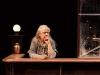
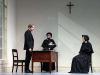
Stewart, who knows theatre upside-down and inside-out, is deserving of an ovation for the cohesive quality of the work. In the first place, he had the good sense to acquire the original set, designed by Neil Gooding Productions, which works well. As someone who should know suggested, it might've made more sense to elevate the orchestra on a scaffold above the drama, but it was more than alright on the night, with the musicians cleverly concealed behind black-painted vertical slats, spaced to take full advantage of Ross Graham's brilliant lighting design. The centre-stage platform was constructed from what appeared to be marble, with industrial grates delineating those panels. It had a striking retro-meets-suburban-meets-high-tech-modernity about it: the slats redolent of the window furnishings of countless estate-clustered homes; the faux marble evoking the laminated 50s kitchen-table; the grates a streamlined reference to gutters and open sewers both historical & metaphorical. The last because The Hatpin relates a true tale of moral sewerage.
It's 1892 on the mean streets of Sydney. Unwed 18-year-old mother, Amber Murray, cast aside by the child's rapist father, and out by her parents, sleeps rough in the reserve, with her beloved babe-in-arms, Horace. (She's not the only shamed young, single mum out there, of course.) Realising the peril Horace is in, she has the enterprise and perspicacity to place an ad in one of Sydney's 53 papers, calling for persons to care for Horace, for a fee, provided she could see him regularly. A pair of trumped-up, ne'er-do-well peacocks, rendered posh purely through inheritance, present themselves. Charles & Agatha Makin, and their reluctant, nose-buried-in-book daughter, Clara. They've no compunction in accepting an upfront payment from Ms Murray, even in knowing full-well she has no shelter, or other real means. They claim to have adopted several others based on similar contracts and to have lost a son of their own.
After countless knockbacks, Amber manages to secure a job in a fruitshop, working for the kindly and compassionate Harriet Piper, who insists also on housing and feeding her. Amber's constant attempts to see her son are met with excuses and evasions. A little digging reveals the identities of the other mothers who've placed their faith in the Makins. Amber appeals to them to help her rescue the lost children, but all, for one reason or another, decline. it's left to Amber to uncover the awful truth, that each baby has lasted barely a week, before being despatched with a hatpin, through the ear. One could hardly invent a more macabre tale.
It's left to Amber, alone, too, to bring the Makins to justice. Alas, evidence is insufficient, so it falls to Clara, the Makin's disenchanted daughter, to rat them out. The cold, cruel Agatha is sentenced to 20 years; the pathetic Charles to hanging.
Recent AIM & Trinity College grad, Sarah Blackstone, who has a fine voice and superb diction (those Brits still have something to teach, after all) gives us a wonderful Amber, replete with what appear to be, possibly, genuine tears. We can't help but feel for this intelligent, strong, determined survivor, whose stout heart and resolved mind never waver from a dead straight moral course.
Penny Stewart, similarly, shines as the maternal, or sisterly, Harriet, an heroic, common woman of uncommon generosity of spirit; a beacon and example to us all. Her vocal delivery, very good at its best, wavered somewhat, but this was probably more due to sound engineering, which was poor, both in terms of the relativity of singing-to-instrumental volume, and clarity. Thus, many lyrics were lost. Fortunately, the gist of the story is not so very difficult to discern.
Ubiquitous stalwart of independent musical theatre, Christopher Hamilton, gives a robustly measured Charles: in equal parts pompous and clueless; stirred, but never really shaken, until the eleventh hour. He is the warning to us all: 'yes, dear' can be taken way too far. Hamilton has a classic, old-school, ever-dependable voice. He, in many ways, is musical theatre.
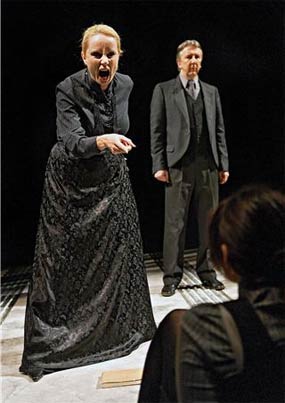
Michele Lansdown's Agatha teetered on crossing the line from histrionic to parodical, at times; then again, the score teeters on the operatic, which brings with it the opportunity for a certain degree of melodramatic licence. She is, nonetheless, utterly convincing as the calculating crone, pushing her lines out with vigour and conviction.
Erin Clare, as Clara, showcased a truly beautiful (to-die-for) voice and, arguably, (even) better mastery of it than any of her peers. Moreover, she really takes her moment, a veritable musical solilioquy, grabbing it, eagerly, with both hands and a great deal of dramatic skill. Superb.
There are some lovely voices lurking in the lesser characters, too: Cara Dibdin, Anna Stallibrass and Katherine Sharpham's, for starters. Ian Johnson is made of similar stuff to Chris Hamilton, but the rich baritone called for by the composer wasn't always completely matched by a slightly breathless performance. Again, I'd lay principal responsibility at the feet of the sound man.
Michael Johnson finds his forte as defence barrister, Thomas Williamson, a condescending sleaze. He's also a refined and confident singer, with a commanding stage presence.
Nelson Padilla, as newspaperman Edward Cleary, while not altogether surefooted, sings well and reflects the complexity of his character with great sensitivity and nuance.
If this is what second-tier musical theatre can deliver to a western Sydney audience on a school holiday Friday, more power to second-tier musical theatre. I see no reason why this production, with the odd tweak and tune-up, couldn't do a Sydney Theatre, or any other stage, quite proud.
NB. A churlish end-note: may I humbly suggest to the good people of the Lyric Ensemble they take a close, long, hard look at photography? The world's worst-lit portraiture, within the programme, does none of the cast any favours, nor does it promote an image of shiny professionalism.
Riverside Lyric Ensemble present
THE HATPIN
music by Peter Rutherford | book & lyrics by James Millar
Directed by Craig Stewart
Venue: Lennox Theatre. Riverside Theatres | Corner Church and Market Streets, Parramatta
Dates: April 9 - 17, 2010
Tickets: $35 / $30
Bookings: 8839 3399 | www.riversideparramatta.com.au